
What Should I Ask Before Hiring a Property Management Company?

What to Ask a Property Management Company Before Signing a Contract
Signing With A Property Management Co.
Plenty of landlords get into real estate investing because they believe renting out properties will be an easy way to bring in some passive income. Quite often, however, people discover that there's more to being a landlord than meets the eye and that they are spending more time than they anticipated tending to the needs of tenants or preparing properties for rental.
That's where the services provided by a property management company can come in handy. If hiring a property manager might be the best option for you at the moment, it's a good idea to know what to look for in a property management company and what questions to ask before working with one.
From the pre-move-in stage to after move-out and all the tasks and responsibilities in between, here are a few questions to ask a property management company before signing a contract with one.
General Questions to Ask Your Property Management Company
First things first. You'll want to ask a few general questions of the company to get a feel for their background, the experience of the people who work there and the policies and procedures in place:
1. How experienced are you with the market in my local area?
Ideally, the company you work with will have years of experience renting and managing properties in your area. You want to find a company that has a track record of growth in the industry. For example, if a property management company started out managing just a handful of properties but today manages upwards of 1000, that's a pretty good sign that it is good at what it does and that it's been able to scale its operations to meet an increase in demand.

It's also worth confirming that the property management company works with the type of properties you own. For example, it doesn't make much sense to approach a company that manages commercial properties if you have residential properties to rent. If you're renting out single-family homes, it's a good idea find a company that manages a portfolio of similar homes.
Another thing to check on is how aware the company's representatives are of the housing and tenant laws in your area. Tenant laws vary by state and in some cases by city or region. You want a company that has a full understanding of fair housing and any other tenant rules. Since there might come a time when you want to begin investing in properties outside of your hometown, it can be useful to find out what other areas, if any, the company works in.
Don't be afraid to ask the company how long it has been operating. It's usually better to partner with a property management company that has at least a few years of experience in the business. At the very least, the company should have more experience in property management and rentals than you do.
2. Will I be working with your main team or a branch office?
If you've ever made an appointment with a doctor only to arrive and have a resident or medical student perform the exam, you know how frustrating it can be to think you're getting one thing only to get something else entirely. While a resident or medical student might be qualified to see you, you had made the appointment expecting to see the more experienced doctor.
To avoid having a similar situation occur when you sign a contract with a property management company, it's a good idea to find out who, exactly, you'll be working with. Some companies are large enough that they have branch offices that oversee clients in particular areas. Others manage everything from a central location.
If you had your heart set on working with a particular person or working with the primary team instead of a branch office, you need to clarify that before you hire the company.
Questions to Ask Your Property Management Company About Their Pre-Move-In Management
Before anyone even moves into a property, there's a lot of work to be done. While you might be able to handle the tasks associated with preparing a rental for a tenant and with finding tenants for an apartment, part of the perks of hiring a property management company is that it should be able to handle many, if not all, of those tasks for you.
To get a sense of how much pre-move-in preparation and management a company provides, ask the following questions:
1. Will you assist in placing a tenant in my property?
One of the things to look for in a property management company is how hands-on it is when it comes to finding tenants for a rental and completing the process of placing a tenant in a property. Some management companies merely focus on the day-to-day operations of a rental. They don't concern themselves with marketing, leases or making sure a potential tenant is a suitable applicant.

Find out how involved the company is when it comes to putting tenants into a rental or if that is a task they leave up to a landlord.
2. Do you screen tenants before allowing them to move into my property?
It's not enough for the property management company to help with placing tenants in your rental properties. Ideally, they will also screen tenants to sort out any who could be potential problems or who could end up not paying their rent.
Along with finding out whether a property management company screens tenants, it's important to find out how they do so. A few options include:
- Running a credit check.
- Verifying source of income/employment.
- Confirming the number of people who will live in the property.
- Checking references.
- Background check.
3. How do you market properties?
Marketing rental properties has gone beyond hanging a "For Rent" sign and putting an ad in the newspaper. Find out if the property management company will market vacant rentals and, if so, how they market available properties. For example, does the company list its available rentals online? Does it create websites and employ search engine best practices to make sure a person who's searching for a rental in a particular area would be likely to find your listing?
4. Do you perform a pre-move-in inspection and walkthrough with the tenant?
Was that dent in the wall there before the tenant moved in or did it occur at some point during their lease? The best way to know is to retain a property management company that conducts a pre-move-in inspection and walkthrough with each tenant.
Part of the inspection and walkthrough should be an inspection checklist. The checklist should document any preexisting damage and if required photographic evidence. It's also important that the tenant sign the checklist, verifying that the apartment or rental was in such condition when they moved in.
5. Will you prepare and renew lease documents for me? Are these unique to each property or are they one-size-fits-all?
Although you can print out lease templates from the internet, the lease you offer your tenants should be a bit more customized than that. Ideally, a property management company will offer lease preparation in some form, up to and including working with a legal team to produce a custom lease that is current when it comes to landlord-tenant law and that includes all the details you want it to include.
Since landlord-tenant laws change on a fairly regular basis, a company that keeps up to date with any developments in the law, and that has an in-house legal team to make sure its leases are within the letter of the law, is a must.
6. Will you help me decide how much I should rent my property for?
Do you know what the market rate is for your rental properties? How can you be sure you're not undercharging tenants? An excellent property management company will know the areas and markets it serves so well that it will be able to recommend the appropriate amount to charge each month based on the location of your properties, their size and any features or amenities they offer.
Usually, a property management company will be able to look at the market and help you set rent based on what similar units are going for.
Additionally, a property management company can provide guidance about raising the rent. They'll help you see if doing so is a good move or if increasing rent would make it more difficult to lease a property or increase the risk that your current tenants move out.
Management Tasks During Tenancy You Should Look For
Although move-in and move-out help are desirable features in a property management company, many landlords are particularly interested in the services the company provides while a tenant is residing in the property. One of the perks of working with a management company is that those 3 a.m. repair and emergency calls become their responsibility instead of yours.
Here are the questions to ask to make sure the company tackles the management tasks you're expecting them to handle:
1. How are maintenance and repairs handled?
If a tenant has a leaky pipe at 2 a.m. or a broken appliance, who do they call — the property management company or you, the landlord? Ideally, the answer is the property management company.
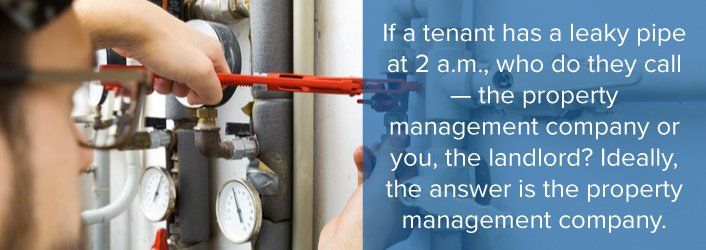
But you want to dig a bit deeper than that. If a tenant has an early-morning or late-night crisis in a rental unit, what does the management company do? Will it send someone out immediately, even if the dead of night, or will it make the tenant wait until morning?
How quickly do they handle repairs that occur at more appropriate hours of the day? For example, if a tenant's air conditioner breaks in the afternoon on a summer's day, will the tenant have to wait a few days before someone comes to look or will they get someone dispatched right away?
2. What other kinds of management tasks does the company perform?
Some property management companies offer repairs and maintenance and that's it. But some provide other services, such as paying any utilities that are the landlord's responsibility or making sure appliances are maintained and serviced on a regular basis. Some companies also offer accounting services to help you track expenses and income so that filing your income tax return is less of a challenge.
3. What kinds of accounting do you offer?
You most likely became a landlord because you wanted to make some additional income. While it's not a service offered by every property management company, some offer accounting and return-on-investment reporting so you can verify whether or not your properties are helping you turn a profit. Some companies also provide tax help by keeping track of income from the properties, utility expenses, licensing and management fees and any other costs associated with renting properties.
4. What do I do if I have a question?
Whether your properties are occupied at the moment or are in the process of being rented out, you want to know who you can turn to if you have any concerns or questions. Some companies will give you the runaround and can make it difficult to speak with an actual person. Others assign you a manager who's your single point of contact any time you have a question, or others provide a point of contact for specific facets of the business to ensure you are speaking with an expert in that facet, as opposed to the single point of contact approach who can only provide general information and is constantly searching for answers to provide you with useful feedback.
If a company doesn't give you a way to get in touch easily or seems hesitant to answer your questions, that's a good sign you're better off working with someone else.
5. Do you offer 24/7 support to my tenants and me?
Disasters tend to strike at the worst possible times. A property management company that shuts down at 5 p.m. on weekdays and goes AWOL on the weekends isn't going to make tenants or landlords very happy. Find out what the company's policy is for support and emergencies. Is there a person to contact or a number to call at all times? Will tenants get the landlord's contact information and be encouraged to get in touch — or will all inquiries, from landlord or tenant, go through the management company?
6. Will you keep me updated on all tenant actions, maintenance, repairs, accounting and so on?
One of the benefits of working with a property management company is that they're there to sweat the small stuff for you. This can be anything from common repairs to more significant legal issues.
Still, you don't want to be kept in the dark about what's going on with your property. Find out how much information the company provides and how frequently it gives it. For example, will you get a monthly report detailing any repairs or maintenance requests? Will the company call you anytime a tenant has a problem?
How does the management company handle your accounts? Will you get monthly statements or will you have to wait until the end of the year to find out how much you spent on your properties and how much each one brought in?
Questions to Ask About Move-Out Management Services
All good things must come to an end and even the best tenants eventually move out. When hiring a property management company, you want to ask questions to find out how they manage the move-out process:
1. Do you perform post-move-out inspections and take care of turnover repairs?
This is similar to the move-in checklist your management company should provide when a tenant moves in. You want the company to do a walkthrough and provide a move-out list to account for any damage that occurred during the lease. This checklist gives you and the property management company an idea of how much repairs will cost and how much of the tenant's security deposit to hang on to for those repairs.
Speaking of repairs, it's a good idea to confirm whether the management company will take care of any work that needs to be completed before the next tenant comes in. Some property management companies have a very short turnover time for repairs. For example, Tenant A moves out at noon one day and Tenant B moves in at noon the next day. Find out how the company handles repairs or if it expects a landlord to take care of them. The time between move-out and move-in is critical to your overall performance, and you need a management company that has well vetted vacancy processes.
2. Will you collect rent and security deposits and return security deposits for me?
It's important to find out how the property management company handles tenant payments. Many will collect rent on behalf of landlords as well as any security deposits, but it doesn't hurt to confirm that the company you are considering does so. As far returning security deposits goes, it's a good idea to find out more about the process the company uses. For example, if a tenant doesn't get the full deposit back, will the management company provide an itemized list to the tenant and landlord explaining the reason why?
3. If necessary, will you help me evict a tenant?
Navigating the eviction process, when and if it becomes necessary, might be one of the least appealing aspects of being a landlord. While you don't want to entirely wash your hands of things, having a property management team in your corner that understands the eviction process and the rules for evicting tenants can be very useful. There are times evictions can escalate into a variety of more complex legal issues, and if you don't have a good management company in your corner, you may find yourself in position that was completely avoidable.
If possible, also find out how the property management company handles other types of tenant-landlord disputes and how the company deals with tenants who might have fallen behind on paying rent.
Contact Harrisburg Property Management Group
Think you're ready to work with a property management company? Learn more about Harrisburg Property Management Group and request a quote for our services today. We're happy to answer any questions you have about working with a property management company. Contact us today.